Storage and Stability of Official Vaccines
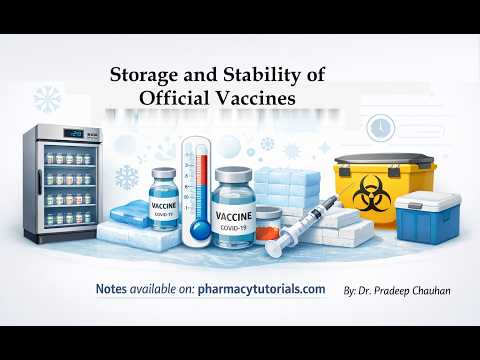
Most vaccines belong to the Inactivated (non-live) and Live attenualted vaccine category. Vaccines are sensitive biological products. When exposed to temperatures outside their required range, their efficacy can be significantly reduced or completely lost. With proper storage and handling guidelines, we can ensure that vaccines remain safe and effective.
Types of Vaccines and Diluents
Inactivated Vaccines
They can be composed of either killed whole cell, or cell fractions of either viruses or bacteria.
- Tetanus, Diphtheria, Pertussis (Tdap/Td)
- Injectable influenza
- Pneumococcal vaccines
- HPV
- Hepatitis A and B
- Meningococcal vaccines
- Zoster (Shingrix)
Live Attenuated Vaccines
A live attenuated vaccines are prepared from living microorganisms that have been weakened, so that they are not able to cause disease in healthy individuals but can produce a strong, long-lasting immune response.
Live attenuated vaccines include:- MMR
- Varicella
- Zostavax
- Nasal spray influenza vaccine
Diluents
Diluents are liquids used with some vaccines. Most vaccines are available in liquid form, ready to be drawn into a syringe and injected. However, some vaccines are provided as a lyophilized (freeze-dried) powder.
A separate liquid (the diluent) is provided for lyophilized vaccines. The diluent must be added to the lyophilized powder before injection, a process called “reconstitution.” A lyophilized vaccine must only be reconstituted with the specific diluent provided for that vaccine; diluents are not interchangeable. Most vaccine diluents may be stored either in the refrigerator or maintained at room temperature.Storage Conditions for Vaccines
Proper storage and stability of vaccines are crucial to preserve their integrity, for maintaining their efficacy and safety. Vaccines, being as biologically active preparations, are sensitive to temperature, light, humidity, and other environmental conditions.
If not stored and handled correctly, vaccines can lose their potency and may not provide the intended protection.- Most vaccines (all inactivated vaccines and live nasal spray influenza vaccine) must be stored between 2° to 8°C (36° to 46°F), which is the recommended refrigerator temperature.
- Live varicella (chickenpox) and Zostavax (shingles) vaccines must be stored frozen between -50° to -15°C (-58° to +5°F). These vaccines may be temporarily stored in a refrigerator (between 2° to 8°C (36° to 46°F) for up to 72 hours before use, if they have not been reconstituted and will be used within that time period. If they are not used within 72 hours, they must be discarded.
- Once the vaccine for reconstitution have been reconstituted (dissolved in diluents), it must be administered within 30 minutes, because they are sensitive vaccines and can lose their efficacy and potency.
- The live MMR vaccine can be stored in either the freezer or the refrigerator. However, once the vaccine has been drawn into the syringe, it must be used within 8 hours or discarded.
- Rotavirus vaccines and yellow fever vaccine should be stored at refrigerator temperature (2°C and 8°C).
- Some vaccines composed of purified antigens or inactivated microorganisms, such as hepatitis A, hepatitis B, Haemophilus influenzae type b (Hib), human papillomavirus (HPV), and inactivated influenza, can lose their potency if frozen and should be kept at refrigerator temperature and never frozen.
| Storage Type | Storage Temperature | Vaccines |
|---|---|---|
| Refrigerator (Most vaccines) | Maintain between 2°C and 8°C (36°F–46°F) | COVID-19 (2024–2025 formulations): • Comirnaty (age 12+ yrs) • Novavax (protein-based COVID-19 vaccine) • Dengue (Dengvaxia) • DTaP (Diphtheria, Tetanus, and acellular Pertussis), DTap, Td (Tetanus and Diphtheria) • Hepatitis A (all) • Hepatitis B (all) • H. influenzae type b (Hib, all) • Human papillomavirus (HPV) • Influenza (all) • MMR (MMR II, Priorix) • Meningococcal (all) • Pneumococcal (all) • Polio (IPV) • Rabies (all) • RSV (Arexvy, Abrysvo) • RSV monoclonal antibody • Rotavirus (all) • Zoster/Shingles (Shingrix) |
| Freezer | Maintain between −15°C and −50°C (−5°F to -58°F) | COVID-19 (2024–2025) Moderna formulations • Mpox (Jynneos) • Varicella Note: Vaccine diluents – Do not freeze |
| Ultra-Cold Freezer | Maintain between −60°C and −90°C (−76°F to −130°F) | Pfizer COVID-19 (pediatric) |
Source: U.S. CENTERS FOR DISEASE CONTROL AND PREVENTION
General management for Vaccine Storage and Transportation
The guidelines were documented by CDC (Centers for Disease Control and Prevention) and WHO (World Health Organization) for the proper storage and handling of vaccines, such as temperature control, inventory management, storage equipment requirements, and documentation procedures.
Maintenance of a "cold chain" from vaccine production to use helps ensure vaccine potency at the time of administration. Temperature monitoring and control are important for storage and handling of all vaccines, particularly during transport and field use.i. Cold Chain Management
The cold chain is the system used to maintain the required temperature range for vaccines during their transportation and storage, from manufacturer to final administration. The cold chain should be maintained through:out the way

ii. Temperature Monitoring and Temperature Monitoring Devices
Temperatures should be monitored at least twice a day, using a temperature monitoring device that records current, maximum, and minimum temperatures.
Temperature monitoring devices are essential to ensure that vaccines are stored within the recommended 2–8°C range. Continuous monitoring helps maintain vaccine potency and prevents loss due to temperature excursions. Commonly used Vaccine Temperature Monitoring Devices are:- Thermometers
- Digital Data Loggers
- Continuous temperature monitoring systems (CTMS) with integrate temperature sensors
- Heat-sensitive chemical indicators i.e. Vaccine Vial Monitors (VVMs)
iii. Minimizing Temperature Fluctuations:
Sudden temperature changes (e.g., from transport or opening the refrigerator door) should be avoided as they can compromise vaccine stability.
iv. Refrigeration Equipment
Vaccines should be kept in original packaging to protect them from light and to avoid contamination.
Different Vaccine Storage equipments- Deep Freezer
- Ice lined Refrigerators
- Cold Boxes
- Vaccine carrier boxes

Ideal method for storing vaccines in a domestic refrigerator:
- Vaccines should always be stored in the middle of the refrigerator or freezer – never in the doors. Because items stored in the door are frequently exposed to warm temperatures when the unit is The refrigerator must be used exclusively for storing vaccines only.
- A label titled "vaccines only" should be affixed to the refrigerator door.
- Vaccines must be stored in labeled plastic containers or baskets to allow for easy identification.
- They should be stored in their original packing for protection against short-term power fluctuations.
- Overcrowding the refrigerator or freezer can impede proper air circulation and temperature regulation, compromising vaccine stability.
Stability of Official Vaccines
The stability of official vaccines refers to the ability of a vaccine to retain its identity, potency, safety, and efficacy throughout its shelf life when stored under recommended conditions, as recognized and standardized by official pharmacopeias or regulatory authorities.
Vaccine stability is a critical quality attribute because vaccines are biological products that are inherently sensitive to environmental factors. Official vaccines must remain stable from the time of manufacture until administration to ensure effective immunization.Factors Affecting Vaccine Stability
1. Temperature
Temperature is the most important factor influencing vaccine stability. Most official vaccines are thermolabile and require storage at 2–8 °C. Exposure to excessive heat can cause protein denaturation, loss of antigenicity, and reduced immunogenicity, while freezing can damage vaccine components, especially adjuvanted vaccines, leading to loss of potency.
2. Light (Radiation)
Some vaccines, particularly live attenuated vaccines, are sensitive to light. Exposure to ultraviolet and high-intensity visible light can cause photodegradation of antigens, resulting in reduced vaccine activity. Therefore, vaccines are often supplied in amber-colored or opaque containers.
Example: The BCG (Bacillus Calmette-Guérin) vaccine is stored in amber-colored bottles to protect it from light sensitivity. Due to the risk of degradation from light exposure, which can cause it to lose potency
3. Moisture and Humidity
Lyophilized (freeze-dried) vaccines are sensitive to moisture. Improper sealing or exposure to humidity can lead to loss of sterility and degradation. These vaccines must be reconstituted only with the recommended diluent and used within the specified time.
4. pH and Chemical Stability
Vaccines are formulated within a specific pH range to maintain antigen stability. Changes in pH during storage may cause hydrolysis or aggregation of proteins, reducing vaccine effectiveness.
5. Formulation Components
Stability is also influenced by excipients such as stabilizers, preservatives, and adjuvants. Stabilizers (e.g., sugars, amino acids) protect antigens from degradation, while improper interaction with adjuvants may reduce immunogenicity.
Stability of Different Types of Official Vaccines
- Live attenuated vaccines: Least stable; highly sensitive to heat and light (e.g., BCG, measles vaccine).
- Inactivated vaccines: More stable than live vaccines but sensitive to freezing (e.g., inactivated polio vaccine).
- Toxoid vaccines: Relatively stable but can lose potency on freezing (e.g., tetanus toxoid).
- Subunit and recombinant vaccines: Stability depends on protein integrity and formulation (e.g., hepatitis B vaccine).
